

You’ve created a free resource, but no one’s signing up. The problem likely lies in your copy – the words you use to present your offer. Effective lead magnet copy grabs attention, communicates value, and convinces visitors to trade their email for your resource. Here’s how to make your copy convert:
- Understand Your Audience: Identify their pain points and offer a solution that addresses their specific struggles.
- Craft a Clear Promise: Focus on a specific, outcome-driven benefit your lead magnet provides.
- Write Attention-Grabbing Headlines: Use clear, direct language that highlights the value and ease of your offer.
- Structure for Clarity: Use headlines, subheadlines, benefit-driven bullet points, and a strong call-to-action.
- Test and Refine: Track metrics like opt-in rates and edit your copy for clarity, brevity, and consistency across platforms.
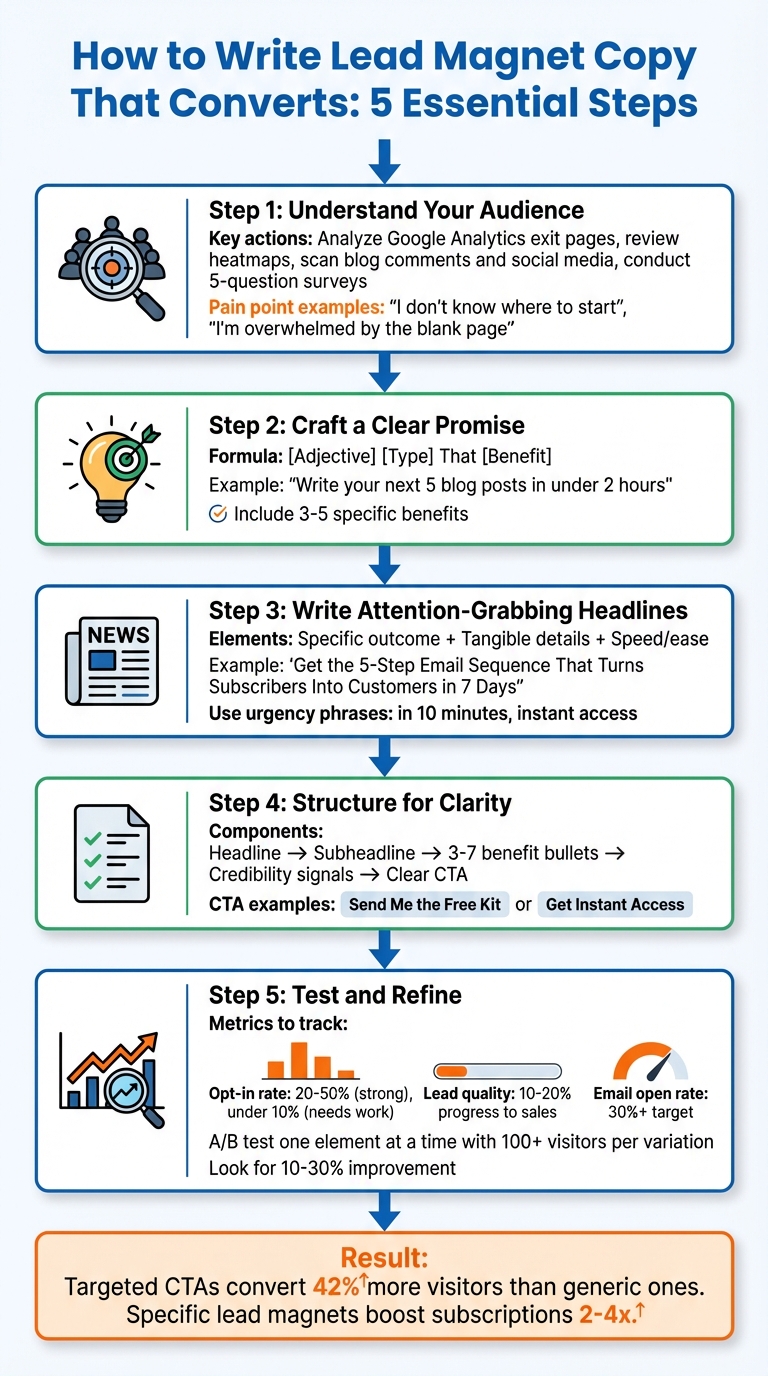
5-Step Lead Magnet Copywriting Process for Higher Conversions
Understanding Your Audience and Offer
To create a high-converting lead magnet, you need to start with a deep understanding of your audience and the exact problem you’re solving. Skipping this crucial step often leads to generic content that fails to connect. By clearly defining your audience and crafting a focused offer, you lay the groundwork for compelling and persuasive copy in the next steps.
Identifying Your Audience’s Pain Points
Digging into your audience’s challenges is key to writing copy that resonates. Start by analyzing data and feedback. Tools like Google Analytics can help you identify high exit pages, while heatmaps reveal where users lose interest. The Google Search Console can highlight what your audience is actively searching for – queries like "funnel templates" or "how to write headlines" can provide valuable insights.
Beyond analytics, pay attention to direct feedback. Scan blog comments, social media discussions, support tickets, and survey responses for recurring frustrations. Phrases like "I don’t know where to start" or "I’m overwhelmed by the blank page" can reveal specific pain points. Keep surveys concise – limit them to five open-ended questions that uncover challenges, such as "What’s your biggest hurdle in content creation?" or "What shortcut would make your work easier?" Competitor reviews are another goldmine for spotting unmet needs.
By pinpointing these recurring challenges, you can tailor your copy to address them head-on. For instance, freelance copywriters might discover their audience struggles with crafting high-converting headlines. A lead magnet that directly solves this problem will naturally attract attention.
Creating a Clear Offer Promise
Once you’ve identified your audience’s struggles, the next step is to craft an offer promise that speaks directly to those issues. Your promise should be specific and outcome-focused. For example, instead of a vague claim like "Improve your blogging", go for something like "Write your next five blog posts in under 2 hours." A simple formula can help: [Adjective] [Type] That [Benefit] – e.g., "The 10-Point Funnel Fix Checklist That Saves Hours of Copywriting."
Your offer promise should hint at a tangible result or quick win. Highlight three to five benefits your lead magnet delivers, such as "Swipeable CTA templates", "A 3-part email sequence", or "Step-by-step guidance for coaches overwhelmed by copy." Adding a reassurance like "No credit card required" can lower barriers and make the offer feel like an easy decision.
Always align your promise with your research. For example, if your audience struggles with creating engaging headlines, a lead magnet titled "Funnel Headline Formulas" will resonate far more than a generic "Content Marketing Guide."
Choosing the Right Lead Magnet Format
The format of your lead magnet should fit both your audience’s preferences and the type of problem you’re solving. Busy professionals often appreciate quick, actionable resources like checklists or cheatsheets. For instance, a "Website Copywriting Audit Checklist" that can be completed in minutes is perfect for those short on time. Templates and swipe files are another great option, especially for overcoming the anxiety of starting from scratch – think email scripts, blog post outlines, or funnel kits.
For topics that require more explanation, consider creating a short guide or mini eBook. Pair it with visuals and action steps to provide clarity without overwhelming the reader. If your audience is willing to dedicate 30–60 minutes, formats like mini-courses, masterclasses, or webinars can work well. These not only solve a problem but also build your authority and naturally lead to your paid offerings. For ecommerce businesses, lead magnets like discounts, free trials, or interactive quizzes can align directly with customer interests and browsing behavior.
Repurposing your best-performing content into lead magnets is another smart strategy. For example, a popular blog post or podcast episode can be transformed into a downloadable resource. According to a HubSpot study, targeted calls-to-action convert up to 42% more visitors than generic ones. Additionally, case studies show that replacing vague offers like "Join our newsletter" with specific, format-matched lead magnets can boost subscription rates by 2–4x.
Writing High-Converting Lead Magnet Copy
Once you’ve nailed down your audience’s needs and crafted a clear offer, it’s time to write copy that converts. To do this, your words need to grab attention, clearly communicate the value, and make signing up an easy decision.
Writing an Attention-Grabbing Headline
Your headline is the first thing people notice, so it needs to pack a punch. It should clearly state what readers will gain and why it’s worth their time. A great headline combines a specific outcome with tangible details and a sense of ease or speed. For instance, instead of saying "Free Marketing Guide", try something like: "Get the 5-Step Email Welcome Sequence That Turns New Subscribers Into Paying Customers in 7 Days" or "Download the 15-Minute Budget Planner That Finds You an Extra $200/Month." These examples include timeframes and dollar amounts that feel relevant and appealing.
To create urgency, use phrases that highlight speed or timing, like "in 10 minutes", "instant access", or "before your next ad goes live." Reassure readers by emphasizing simplicity with terms like "step-by-step", "plug-and-play", or "no tech skills needed." Headlines like these not only grab attention but also make the offer feel achievable.
Structuring the Copy for Clarity and Persuasion
Great lead magnet copy follows a straightforward structure: headline, subheadline, benefit bullets, credibility signals, and a clear call to action.
- Subheadline: Build on the headline by identifying your audience and detailing the promised transformation. For example: "Perfect for solo U.S. small-business owners who want more leads without spending hours writing copy."
- Opening Paragraph: Keep it short – just two or three lines that address your audience’s pain points and position your lead magnet as the solution. For example: "Struggling to figure out what to say on your opt-in pages? This free checklist shows you exactly what to include – so you can turn visitors into subscribers in under 20 minutes." Short sentences and plenty of white space make your message easy to read on any device.
- Benefit Bullets: List three to seven bullet points that turn features into benefits. Don’t just say what’s included – explain why it matters. For example:
- "The 3 subject line formulas we use to boost open rates – so your emails stop getting ignored."
- "A plug-and-play tracking sheet that reveals where your best leads come from – no fancy software needed." Use action-oriented phrases like "Discover…", "Learn how…", or "Get the exact…" to make the value pop.
- Credibility Signals: Build trust with a testimonial, a quick results stat, or an authority mention. For example:
- A testimonial block with one to three quotes.
- A results bar like: "Over 1,000 marketers have used this checklist to improve their opt-in rates."
- A credibility tag under the headline, such as: "Created by a conversion copywriter featured in top industry publications."
- Call to Action: Be clear and specific. Avoid generic button text like "Submit." Instead, use phrases like "Send Me the Free Kit," "Get Instant Access," or "Unlock the Swipe File." Add microcopy near the button, such as "Yours instantly – no credit card needed," to ease concerns and make signing up feel effortless.
Using Conversational American English
To connect with your audience, write in conversational American English. Use everyday language, contractions (like "you’ll" and "don’t"), and a direct, friendly tone. Swap out formal or technical jargon for phrases like "right now", "get more leads", or "save time." Speak directly to your reader with "you" instead of "we", and use rhetorical questions to draw them in: "Wish your lead magnets actually got downloaded?"
Show enthusiasm, but balance it with honesty. For example, be upfront about limitations: "This won’t write all your emails for you, but it’ll give you proven templates to start from." Avoid overused phrases like "secret hack" or "game-changer", and steer clear of unexplained acronyms that might confuse beginners. By focusing on specific, realistic outcomes – like "email list", "website visitors", or "extra $500/month" – your copy will feel relatable, trustworthy, and persuasive to U.S. audiences.
sbb-itb-112c64b
Testing and Refining Your Lead Magnet Copy
Once you’ve written your lead magnet copy, the job isn’t over. The next steps – editing, tracking performance, and ensuring consistency – are where the magic happens. Crafting effective copy is an ongoing process that requires tweaks and adjustments to maximize results. Here’s how to refine your work and keep it performing at its best.
Editing for Clarity and Brevity
Start with a quick editing pass to sharpen your copy. Replace vague phrases like "amazing results" with specific, measurable outcomes such as "increase opt-ins by 25%" or "save 5 hours each week." Cut unnecessary fluff by trimming your word count by about 20–30%. Stick to active voice, aim for sentences under 20 words, and break up paragraphs into bite-sized chunks of 3–5 lines for easy reading. To make your copy scannable, use bold subheadings, bullet points, and plenty of white space to guide the reader’s eye.
Tracking Performance Metrics
Once your lead magnet is live, it’s time to dive into the numbers. Keep a close eye on your opt-in rate – a strong page should convert 20% to 50% of visitors. If your rate is under 10%, it’s a sign that your headline or offer might need reworking. Beyond opt-ins, track the quality of your leads by monitoring how many progress to actual sales (10–20% is a solid benchmark) and check email open rates (aim for 30% or higher).
Use tools like Google Analytics or your email platform to compare page views to sign-ups, and evaluate post-opt-in engagement. If leads aren’t converting into customers, your copy might be overpromising. Adjust your headline to better reflect what you’re offering – swap vague claims for specifics, like "5 Proven Templates" instead of generic benefits. Test one element at a time, such as headlines, CTAs, or bullet points, using A/B testing platforms like Google Optimize. Run each test with at least 100 visitors per variation, and look for improvements of 10–30% in opt-in rates before locking in changes.
Ensuring Consistency Across Channels
Your lead magnet copy should feel seamless no matter where someone encounters it – whether on your blog, social media, or email opt-in form. A consistent tone and message build trust and can improve conversions by 20–30%. Mismatched messaging – like a formal blog paired with overly casual social posts – can confuse potential leads.
To maintain uniformity, create a simple style guide outlining your tone (e.g., friendly and benefit-driven), key phrases (like "Instant Access Checklist"), and CTA language. Make sure ad headlines align with your opt-in page, and regularly audit your channels – at least quarterly – to catch any inconsistencies. Use conversational American English, include specific numbers and timeframes, and ensure every touchpoint smoothly guides visitors from discovery to sign-up. A cohesive message strengthens your brand and keeps your audience engaged.
Conclusion
Recap of the Copywriting Process
Let’s sum up the key steps for creating lead magnet copy that drives conversions. First, get to know your audience deeply – pinpoint their challenges and offer a clear, specific solution. Next, craft persuasive copy with attention-grabbing headlines, a logical flow, and a conversational tone that resonates. Finally, test and refine your work – edit for clarity, monitor opt-in rates, and ensure your messaging stays consistent across all platforms. For example, Teachable boosted its conversion rate by 25% after revising its copy to directly address audience pain points.
With these strategies, you’ve got the tools to make immediate improvements.
Next Steps
Now it’s time to put these ideas into practice. Start by auditing one of your existing lead magnets. Take a close look at its headline, structure, and tone, and apply these steps to enhance its effectiveness. If you’re starting from scratch, focus on writing and testing a strong headline and subheadline combo. Launch it on a landing page and track opt-in rates over the next 30 days. You can also experiment with A/B testing – try different calls-to-action like “Get Instant Access” versus “Send Me the Free Kit,” or replace bullet lists with visuals to see what works better.
For inspiration, consider CopyPosse’s 2023 lead magnet tutorials. These were designed to address specific audience questions and resulted in a 25% increase in opt-ins by using targeted email campaign frameworks that tackled initial pain points. The result? Users were eager to dive into full courses. Your first optimized lead magnet could achieve similar success. It’s time to start converting more leads today.
FAQs
How do I figure out my audience’s biggest challenges to create better lead magnet copy?
To get a clear picture of your audience’s biggest hurdles, start by running surveys or polls to collect their direct input. Dive into comments, reviews, and social media conversations – these are goldmines for uncovering frustrations or unmet needs. Another smart move is to analyze frequently asked questions or recurring concerns within your niche.
When you weave these insights into your lead magnet copy, you’ll create content that resonates deeply and feels genuinely useful to your audience.
What are some examples of attention-grabbing headlines for lead magnets?
To craft attention-grabbing headlines for lead magnets, focus on showcasing the value and directly addressing a specific problem your audience wants to solve. Here are some examples:
- "Download Your Free Guide to Achieve [Benefit]"
- "Unlock the Secrets to [Desired Result]"
- "Get Instant Access to [Solution] That Works"
- "Transform Your [Challenge] with This Free Resource"
- "Start Reaching [Goal] Today – For Free!"
These headlines work because they promise clear benefits and tackle pain points your audience cares about. Keep them short, straightforward, and action-driven to encourage clicks and boost conversions.
How can I test and improve my lead magnet copy to boost conversions?
To fine-tune your lead magnet copy, start with A/B testing. This method lets you compare different versions to see which one connects better with your audience. Keep an eye on key metrics like click-through rates and conversion rates to gauge performance.
Beyond numbers, gather direct feedback from your audience through surveys or comments. This can offer valuable insights into their preferences. Use what you learn to tweak your copy’s tone, structure, and persuasive elements in small, manageable steps.
Refining your copy isn’t a one-and-done task – it’s an ongoing process. Keep testing and adjusting over time to ensure your content stays effective and engaging.