
Want to write emails that people actually open and act on? Psychology holds the key. Here’s why:
- 47% of people decide to open an email based on the subject line alone, often in just 3–5 seconds.
- Personalized emails can drive transaction rates 6x higher than generic ones.
- Tactics like loss aversion and social proof can boost conversions by 158%.
This guide breaks down the psychological principles – like anchoring bias, reciprocity, and FOMO – that make email copy effective. You’ll also learn proven frameworks like AIDA and PAS, plus actionable tips to write emails that trigger emotional responses and drive results. Whether you’re crafting subject lines, building trust, or creating urgency, every strategy is backed by data and real-world examples.
Let’s dive into how understanding the human brain can transform your email marketing.
Mastering Email Marketing: The Psychology of Persuasion Revealed
Core Psychological Principles in Email Copy
Cognitive biases play a big role in how we process information and make decisions, especially when reading emails. By understanding three key principles – anchoring bias, reciprocity, and loss aversion – you can craft emails that naturally guide readers toward taking action.
Anchoring Bias in Subject Lines and Offers
Anchoring bias happens when people give too much weight to the first piece of information they see. In email marketing, this is often used in pricing strategies. For instance, showing an original price with a strikethrough next to a discounted price makes the discount feel much bigger than it actually is.
Subject lines with numbers have a 57% higher open rate and even trigger dopamine release. A study by Northcraft and Neale revealed that both real estate experts and students overvalued homes when exposed to inflated reference prices. This shows how powerful anchoring can be.
Another example is the "left-digit effect." A price like $4.99 feels cheaper than $5 because the brain focuses on the "4." Similarly, $99 feels noticeably less than $100. You can use this principle in your email offers by showing tiered pricing options. For instance, place an annual plan at $500/year next to a monthly plan at $50/month. The higher annual price will anchor the perception, making the monthly plan seem more affordable.
William Poundstone, author of Priceless: The Myth of Fair Value, explains this concept well:
"Marketers and salespeople knew too well that what a customer was willing to pay was changeable and that there was money to be made from that fact."
Anchoring also works in the body of your email. For example, placing a $75 pair of headphones next to a $150 premium version makes the $75 option seem like a bargain. This tactic has been shown to increase gross profits by an average of 6%.
Once you’ve captured attention with anchoring, the next step is to build trust through reciprocity.
Reciprocity Principle for Building Trust
Reciprocity is the idea that when someone receives something valuable, they feel an obligation to give something back. This principle is especially effective for engaging new leads, recovering abandoned carts, or reactivating inactive customers. The trick? Offer value first before asking for anything in return.
A smart approach is to structure your email sequences with a "give-to-ask" ratio. For example, send two emails offering free resources – like a checklist, template, or guide – before asking for a purchase or demo booking. This positions your brand as helpful rather than sales-focused.
Alexis Rodrigo, writing for Vero, explains it well:
"People who feel indebted to you will more easily comply with your request."
The value you give doesn’t have to match what you’re asking for later. For instance, a free eBook solving a specific problem could lead to a $500 purchase because of its perceived usefulness. Lead magnets like calculators, checklists, or quick solutions work well because they showcase expertise while building goodwill.
You can also mix value and a pitch in the same email, as long as the focus stays on helping the reader. Adding unexpected bonuses – like exclusive tips, sneak peeks, or surprise discounts – can amplify the reciprocity effect by feeling like a genuine gift.
Once trust is established, use loss aversion to encourage immediate action.
Loss Aversion and FOMO Tactics
Loss aversion is the idea that people are more motivated to avoid losses than to achieve gains. This is why emails emphasizing what readers might miss out on often perform better than those focused on benefits. Daniel Kahneman’s research has shaped how marketers use urgency and scarcity in their messaging.
Here’s how the concepts differ:
- Urgency is time-based, like “Sale ends tonight.”
- Scarcity highlights limited availability, such as “Only 5 left in stock.”
- Loss aversion focuses on the consequences of not acting, like paying more later or missing out entirely.
In a test for the Nudge Podcast, Phill Agnew found that a loss-aversion subject line – "Don’t miss this one" – boosted open rates by 13.3% and click rates by 12.5% compared to the control subject line "Listen to this one".
In 2022, mattress brand Leesa used a loss-aversion strategy with the subject line "2 days till price increases take effect." The email combined urgency (a deadline), scarcity (limited affordable options), and loss (higher future costs) while maintaining transparency about the price hike. This approach drove action while keeping customer trust intact.
Another example comes from the PadelLab Team, which promoted their "Velocity Pro 2.0" shoes with an email stating, "We’re already running low on the most popular sizes… Once they’re gone, they won’t be restocked until next month." They also offered a 24-hour early access window for subscribers, creating exclusivity and urgency.
When presenting offers, frame them in terms of what the reader risks losing. Instead of saying, "Act now and get benefits", try, "Act now before you miss out." Be specific – "2 days till price increases" is far more compelling than a vague "Sale ending soon." Combining FOMO with social proof (like how many others have purchased) and explaining the reason for scarcity or urgency (e.g., limited production) helps avoid coming across as manipulative while driving results.
Advanced Personalization and Emotional Appeal Techniques
Taking psychological triggers to the next level, advanced personalization and emotional appeal techniques help you forge a deeper connection with your audience. The true strength of email copy lies in crafting messages that feel tailor-made for each recipient, using behavioral insights, emotional hooks, and trust-building elements to keep readers engaged.
Personalization Beyond Names
Personalization isn’t just about adding someone’s first name – it’s about understanding their behavior. By analyzing data like browsing habits, past purchases, or app usage, you can create recommendations that feel genuinely helpful rather than generic. For instance, dynamic content blocks can switch out entire sections of an email – images, text, or offers – based on details like location, gender, or even the recipient’s company name.
And the numbers back it up. Emails with personalized subject lines see a 26% boost in open rates. Campaigns featuring personalization generate revenue 5.7 times higher, and personalized emails achieve six times the transaction rates of their generic counterparts. Plus, 74% of marketers report higher customer engagement through targeted personalization, with an average sales increase of 20% when personalized experiences are used.
A clever but underused tactic is dynamically changing the "from" name to match the account manager or sales rep a subscriber already knows. Why does this matter? Because 68% of Americans decide to open an email based on the sender’s name. Similarly, swapping images to reflect the subscriber’s location can increase click-through rates by 29%.
Beyond data-driven tweaks, language plays a big role. Words that appeal to the senses can make your message more vivid and memorable. For example, instead of saying, "Our software is fast", try, "Watch your reports load in seconds", to help readers picture the experience.
Social Proof and Authority Triggers
People trust what others endorse. Case in point: 63% of consumers are more likely to make a purchase when a site includes product ratings and reviews. Emails that integrate social proof can achieve 73% higher click-through rates and a 158% boost in conversions.
There are four types of social proof you can weave into your emails: expert endorsements, user testimonials, crowd validation (like "Join 50,000+ marketers"), and peer success stories. A great tactic is placing a concise testimonial right above your call-to-action button to address any lingering doubts.
In 2024, Phill Agnew, host of the Nudge podcast, tested social proof in subject lines. A control subject line, "New Nudge: Why Brands Should Flaunt Their Flaws", was compared to one including "(100,000 Downloads)." The version with social proof saw open rates jump from 22% to 28%, while click rates doubled.
Authority works differently but is equally effective. It’s built through titles (like Dr., CEO, or Founder), credentials (certifications or awards), and appearances in respected outlets like Forbes or TechCrunch. As Robert Cialdini, a leading psychologist, states:
"People will do things that they see other people are doing."
Even small details, like using real customer photos instead of polished studio shots, can build trust faster. User-generated content feels more relatable, with 91% of people trusting peer recommendations over brand messaging.
While social proof strengthens credibility, appealing to emotions takes trust to the next level and inspires action.
Empathy and Positive Framing Techniques
The way you frame an offer can significantly influence how readers respond. One effective approach is the Problem-Agitation-Solution (PAS) framework. This method connects with readers by identifying their pain points, amplifying the emotional impact, and offering your product as the solution. For example, an e-commerce brand tackling cart abandonment might highlight the frustration of missing out on limited stock, then introduce a feature that reserves items for 24 hours.
Another approach, the Before-After-Bridge (BAB) framework, focuses on transformation. It paints a picture of what life could look like after using your solution, making the outcome feel achievable. Descriptive language helps readers visualize success, especially since people retain 65% of visual information even days later.
Images of human faces can also create emotional connections. The brain’s fusiform face area responds strongly to faces, making them a powerful tool for fostering trust. Strategically placing images of people looking toward your call-to-action button can subtly guide readers’ attention to where you want it.
Lastly, don’t overwhelm readers with too many choices. Offering too many options can lead to "analysis paralysis", where overthinking prevents action. Simplify your emails by focusing on one clear call-to-action and framing it around the emotional benefit for the reader.
sbb-itb-112c64b
How to Apply Psychological Principles in Your Emails
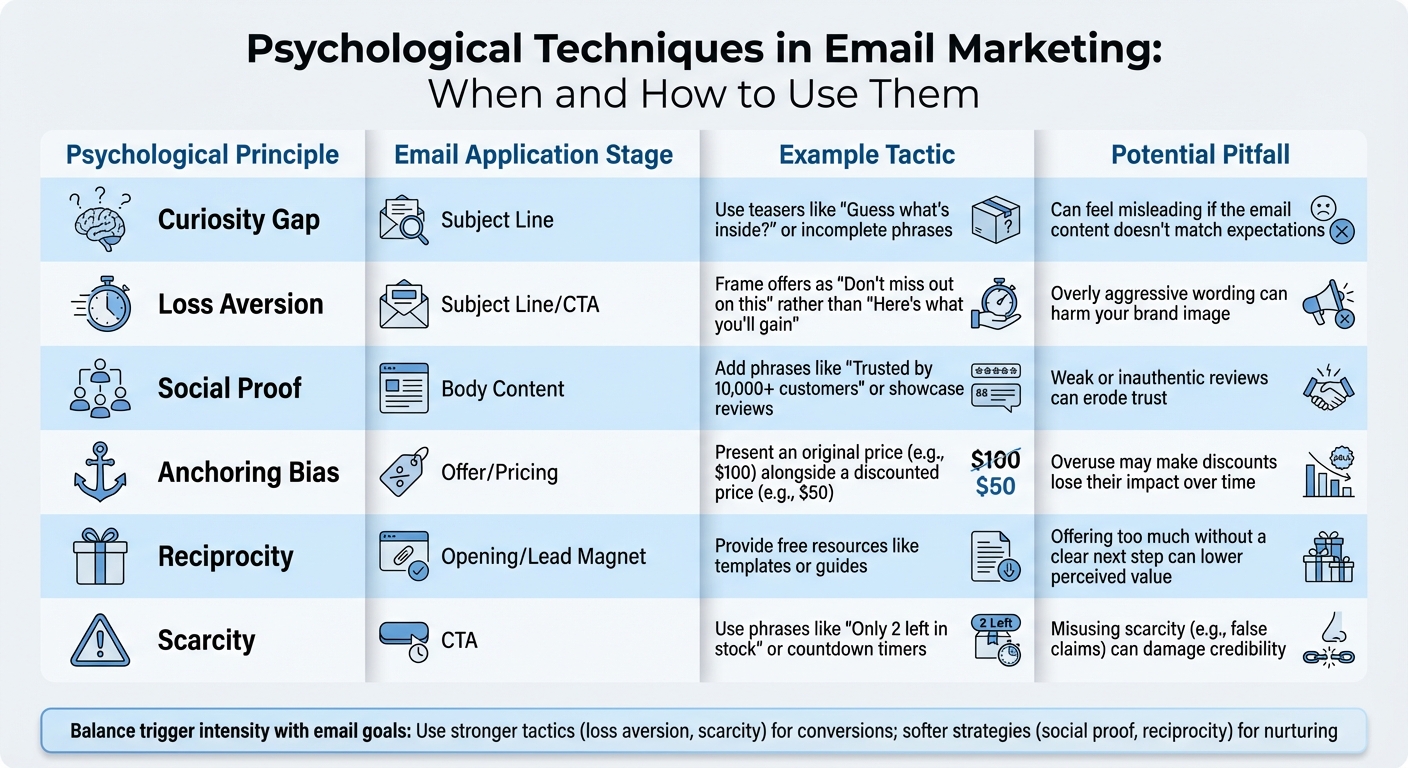
Email Psychology Techniques: Application Stages and Best Practices
Mapping Psychological Principles to Email Copy
To make your email campaigns more effective, align psychological triggers with the specific sections of your email. The AIDA framework – Attention, Interest, Desire, Action – offers a reliable way to strategically apply these principles throughout your message.
Start with your subject line, which must grab attention instantly. This is where tactics like curiosity gaps, urgency, scarcity, and pattern interrupts shine. Including numbers can also make a difference; subject lines with numbers have been shown to boost open rates by 57%.
The email body is your chance to sustain interest and create desire. Frameworks like PAS (Problem-Agitation-Solution) and BAB (Before-After-Bridge) can guide your messaging. Highlight pain points, show the solution, and help readers envision a better outcome. Adding social proof, such as testimonials, and using sensory language can keep your audience engaged.
Finally, your call-to-action (CTA) should reduce hesitation. Leverage strategies like risk reversal, scarcity, and reminders of past value. Keep the choices simple – research on the "Paradox of Choice" found that limiting options from 24 to 6 increased conversions from 3% to 30%. These approaches ensure your email flows seamlessly from one stage to the next.
Comparison Table of Psychological Techniques
Certain psychological techniques are more effective at specific points in your email. Here’s a breakdown:
| Psychological Principle | Email Application Stage | Example Tactic | Potential Pitfall |
|---|---|---|---|
| Curiosity Gap | Subject Line | Use teasers like "Guess what’s inside?" or incomplete phrases | Can feel misleading if the email content doesn’t match expectations |
| Loss Aversion | Subject Line/CTA | Frame offers as "Don’t miss out on this" rather than "Here’s what you’ll gain" | Overly aggressive wording can harm your brand image |
| Social Proof | Body Content | Add phrases like "Trusted by 10,000+ customers" or showcase reviews | Weak or inauthentic reviews can erode trust |
| Anchoring Bias | Offer/Pricing | Present an original price (e.g., $100) alongside a discounted price (e.g., $50) | Overuse may make discounts lose their impact over time |
| Reciprocity | Opening/Lead Magnet | Provide free resources like templates or guides | Offering too much without a clear next step can lower perceived value |
| Scarcity | CTA | Use phrases like "Only 2 left in stock" or countdown timers | Misusing scarcity (e.g., false claims) can damage credibility |
The trick is to balance the intensity of these triggers with the goal of your email. For high-stakes conversions, stronger tactics like loss aversion and scarcity can be effective. For nurturing campaigns, softer strategies like social proof and reciprocity are better suited. Nobel Laureate Richard Thaler sums it up perfectly:
"If you want to get people to do something, make it easy. Remove the obstacles".
Conclusion and Key Takeaways
Final Thoughts
Understanding human psychology is the secret sauce that separates emails that grab attention from those that get ignored. The strategies and triggers we’ve discussed work because they tap into how people naturally make decisions. Emotion drives decisions, while logic steps in to justify them.
Start small and test consistently. Try focusing on one principle at a time – like using loss aversion in your subject lines or incorporating social proof into your email copy – and track the results. In a sea of emails, standing out means knowing what sparks curiosity, engagement, and action.
Personalization is a game-changer for boosting engagement and revenue. But it’s more than just dropping a first name into your greeting. True personalization means crafting messages that align with your audience’s specific needs and challenges, no matter where they are in their journey.
With these insights in hand, you’re ready to take your email strategy to the next level.
Next Steps for Bloggers
Now that you’ve got the tools, it’s time to put them into action. Start by weaving these psychological principles into your email strategy. Experiment with different frameworks, keep a close eye on your metrics, and fine-tune your approach to stand out from those who rely on guesswork. These tactics not only improve your emails but also help drive your blog’s growth and monetization efforts by encouraging your audience to engage more deeply with your content.
Blogger Outline offers a wealth of resources and expert advice to help you sharpen your email copywriting skills. From SEO optimization to audience engagement and monetization strategies, the platform is designed to support bloggers at every stage – whether you’re just starting out or looking to scale. Pick one psychological trigger to test this week and use the results to refine your email game.
FAQs
What is anchoring bias, and how can I use it in email marketing?
Anchoring bias refers to our natural tendency to rely heavily on the first piece of information we encounter when making decisions. In email marketing, this psychological quirk can be a game-changer in shaping how readers view your offers.
Here’s how you can use anchoring bias to your advantage:
- Start with a bold number: Use the subject line or opening sentence to highlight a compelling figure (e.g., "Save $50 on our $199 plan"). This makes the discounted price stand out as an attractive deal.
- Lead with a premium option: Present the most expensive choice first. This makes other options appear more affordable or appealing by comparison.
- Create urgency early: Set a deadline upfront (e.g., "Only 48 hours left to claim this offer") to encourage quicker decisions.
- Leverage social proof: Include specific numbers to build trust (e.g., "Join 12,345 happy customers").
Keep your message short and emphasize the benefits tied to the anchor to maximize its impact. If you’re looking for tools to streamline this process, Blogger Outline offers templates designed specifically for email campaigns.
What are some effective ways to use reciprocity in email marketing?
Reciprocity in email marketing is all about giving your subscribers something worthwhile to establish trust and spark engagement. Think along the lines of offering a free ebook, exclusive discount codes, or even a complimentary checklist. These small but meaningful gestures can foster goodwill, making your audience more inclined to take action – whether that’s purchasing your product, signing up for a service, or sharing your content with their network.
How does personalization improve email engagement and conversions?
Personalization transforms your emails from generic broadcasts into meaningful conversations, making recipients feel seen and appreciated. By using details like a subscriber’s name, referencing their previous actions (like purchases or browsing history), or tailoring offers to match their interests, your emails become much more engaging and relevant.
This approach taps into a psychological concept called self-relevance – people are naturally drawn to content that feels personal to them. When emails feel timely and meaningful, they’re more likely to grab attention, leading to higher open rates, improved click-through rates, and stronger conversions. Bloggers can leverage tools to segment their audience, create dynamic content, and craft messages that truly connect with their readers, delivering better results across the board.