

Repurposing content is a cost-effective way to increase engagement, reach, and leads without creating new material from scratch. By reformatting existing blog posts into videos, infographics, social media posts, or email campaigns, bloggers can save time, cut costs, and grow their audience.
Key takeaways:
- Cost savings: Repurposing costs $50–$200 per piece vs. $500–$2,000 for new content.
- Higher engagement: 3.5x more engagement and up to 300% reach increase.
- Efficiency: 4–6 hours to repurpose vs. 8–12 hours to create new content.
- Proven success: Case studies show boosts in organic traffic, leads, and clicks.
For example, Lauren Fox increased blog traffic from 20,000 to 200,000 monthly visitors by updating and repurposing old posts. Tools like Google Analytics and AI can help identify high-performing content to repurpose, track ROI, and streamline the process.
This approach allows you to maximize the value of your existing content while maintaining a consistent publishing schedule across platforms.
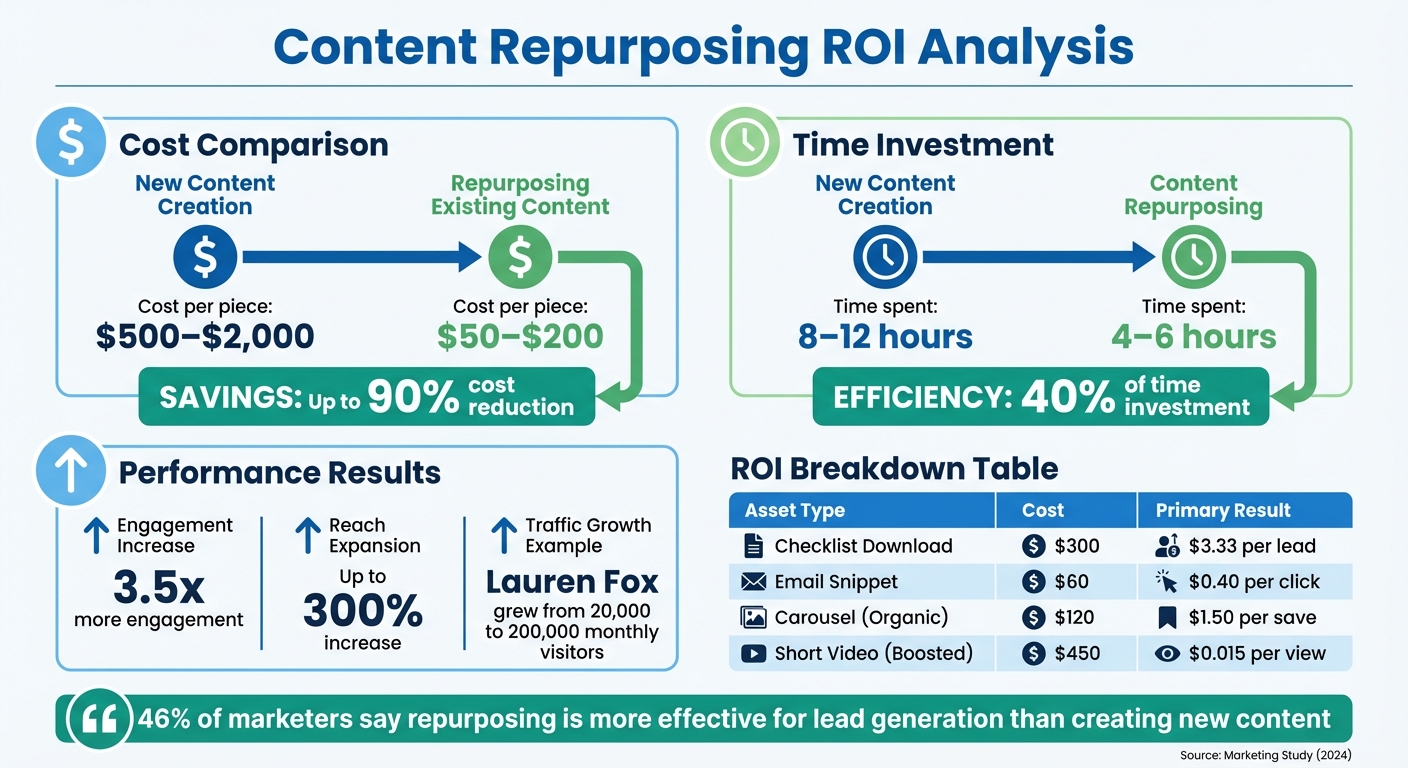
Content Repurposing ROI: Cost, Time & Engagement Comparison
8 Simple Ways to Repurpose Content for More Traffic
sbb-itb-112c64b
How to Measure ROI in Content Repurposing
Measuring the ROI of content repurposing is all about connecting efficiency gains to better engagement and lead generation. The key is tracking metrics that highlight real performance improvements and cost savings – not just surface-level stats that look impressive but lack substance.
Engagement and Traffic Growth Metrics
To start, keep an eye on impressions (how often your content shows up) and unique reach (how many individual people see it). These numbers help you understand if your repurposed content is reaching a broader audience compared to the original. You can calculate your engagement rate by dividing total engagement actions (like clicks, likes, or shares) by your reach.
For those focused on SEO, tools like Google Search Console can track page-one keyword rankings and organic search impressions. Research shows that updating older posts with fresh visuals, newer publication dates, and filling in topic gaps can significantly boost organic impressions, clicks, and keyword rankings.
A real-world example? Neil Patel’s team at NP Digital repurposed a "Website Migration" guide into multiple formats. The original blog post generated 52,600 impressions and 250 clicks. When repurposed into LinkedIn posts with expert narration, it brought in an additional 4,700 impressions and a 6.45% engagement rate. This highlights how repurposing into different formats can dramatically extend your content’s reach.
Once you’ve evaluated engagement, the next step is to measure how effectively repurposed content turns visitors into leads.
Lead Generation and Conversion Rates
It’s not just about traffic – what matters is how well your repurposed content drives conversions. This includes actions like form submissions, email signups, gated content downloads, or demo requests. Using UTM parameters in Google Analytics can help you pinpoint which formats are driving these conversions.
The numbers don’t lie: 46% of marketers say repurposing content is more effective for generating leads than creating entirely new pieces. To measure your success, compare the performance of repurposed content with the original. For instance, if a blog post initially generated 50 email signups and a repurposed checklist brings in 90 more, you’ve nearly tripled your leads using the same core material.
Cost-Per-Lead and Time Efficiency Analysis
To get the full ROI picture, you also need to evaluate cost and time efficiency. Start by calculating your cost per lead (CPL). Take the total investment (including labor costs, such as $60/hour for internal time) and divide it by the number of conversions.
Here’s a breakdown:
| Asset Type | Cost Basis | Primary Metric | ROI Calculation |
|---|---|---|---|
| Checklist Download | $300 (Design/Copy) | Cost Per Lead | $300 ÷ 90 leads = $3.33 per lead |
| Email Snippet | $60 (Internal Time) | Cost Per Click | $60 ÷ 150 clicks = $0.40 per click |
| Carousel (Organic) | $120 (Internal Time) | Cost Per Save | $120 ÷ 80 saves = $1.50 per save |
| Short Video (Boosted) | $450 (Spend + Time) | Cost Per View | $450 ÷ 30,000 views = $0.015 per view |
Repurposing content costs between $50 and $200 and typically takes 4–6 hours. This equates to about 40% of the time investment for a potential 300% increase in reach. Using AI tools, which cost around $20–$50 per month, can slash costs by up to 90% compared to hiring freelancers.
"Repurposing blog content works when you treat it like a measurable distribution system, not a creative shortcut." – Madison Hayes, Social Media Marketing Contributor, InfluencerDB
To make repurposing worth the effort, aim for at least a 5x increase in reach from 4 hours of work at a $25/hour contractor rate. Use this as a benchmark to decide which archived posts are worth repurposing.
Practical Strategies for Content Repurposing
Once you’ve identified content that delivers strong ROI, the next step is making it work even harder for you. Repurposing isn’t about reinventing the wheel – it’s about squeezing more value out of what you already have.
Finding High-Value Archived Content
Start by identifying your best-performing content. Use Google Analytics to navigate to Behavior > Site Content > All Pages and look for posts that consistently attract traffic. But don’t stop there – dig deeper into engagement metrics like time on page, bounce rates, and social shares to find content that resonates with your audience.
Focus on evergreen content – pieces that hold their relevance over time, such as how-to guides, tutorials, or industry best practices. These are the gift that keeps on giving, staying useful even as trends evolve. Also, prioritize content that already converts visitors into leads or subscribers. Posts with strong backlinks? Another great pick – they signal authority and are ripe for reformatting.
"When you identify your top-performing ‘pillar’ content – the pieces that genuinely connect with your audience – you can unlock their hidden potential. Imagine turning one in-depth guide into a month’s worth of conversations across all your channels." – PostSyncer
To organize your efforts, sort your content into three categories:
- "Repurpose Now": Evergreen, high-performing pieces ready for transformation.
- "Update & Repurpose": Solid content that needs updated stats or refreshed details before repurposing.
- "Leave As Is": Low-performing or time-sensitive posts that aren’t worth the effort.
Use the "High Time/Low Views" rule to spot hidden gems. If a post has high time-on-page but low views, it means the content is good, but its format or distribution fell short. Consider repackaging it into a more engaging format like a video or infographic.
Best Formats for Repurposed Content
The format you choose can make or break how far your content travels. A good rule of thumb? Follow the 1:10 rule: aim to create 10 different assets from every flagship blog post. Break your content into smaller "atoms" – key stats, quotes, frameworks, or steps – and rebuild them into new formats.
Video is king when it comes to engagement. Convert blog hooks into 15–90 second clips for platforms like Instagram, TikTok, or YouTube Shorts. Short-form video content often outperforms standalone pieces, generating 40% more views. For LinkedIn, turn key blog points into carousels, visual slide decks designed to boost swipe-through engagement. On X (formerly Twitter), break down long-form content into threads of 8-15 tweets, starting with an eye-catching claim and ending with a link to the full post.
Email sequences are another effective option. Transform a blog post into a 5-part email series:
- Share the main insight.
- Dive deeper into the topic.
- Provide actionable steps or a checklist.
- Highlight a case study.
- Wrap up with a call-to-action.
For visual learners, create infographics. Extract stats or process maps and share them on Pinterest, where they can earn backlinks and drive traffic. For example, HubSpot turned its "2024 State of Marketing Report" into an infographic that highlighted key trends for social sharing. Ahrefs took a YouTube video on "ChatGPT for SEO" and expanded it into a detailed blog post with the video embedded.
"I start thinking about repurposing opportunities from the moment I’m reviewing a content brief. It’s a strategic part of content creation, with an eye on lifecycle and future engagement." – Chima Mmeje, Senior Content Marketing Manager, Moz
Platform-Specific Distribution Tactics
Every platform has its own quirks, and success comes from adapting your content – not just reposting it. Use the 5×5 Distribution Map: reformat content into five types (text post, carousel, short video, email snippet, checklist) and share across five channels (LinkedIn, Instagram, TikTok, YouTube, Email).
For LinkedIn, carousels work well for step-by-step guides, while text posts are great for personal stories. To avoid algorithm penalties, place external links in the first comment rather than the post itself. On YouTube, focus on the first 30 seconds to grab attention and use search-friendly titles with custom thumbnails. For TikTok and Instagram Reels, stick to one tip per video and always include captions, as many users watch without sound.
When crafting email campaigns, don’t copy-paste entire blog posts. Instead, highlight 3-5 key takeaways in bullet points with personal commentary and a clear call-to-action. Some brands, like The Know, repurpose newsletter content into short Instagram Reels, where creators read headlines in a list format, driving traffic back to the newsletter.
Timing also plays a role. Release repurposed content in waves: share the first wave within a week for freshness, and follow up 30-60 days later with a new angle or updated data. This keeps your content relevant without overwhelming your audience.
"The two biggest mistakes are assuming you need to repurpose content into dozens of formats and then share it on every platform possible… Executing fewer things consistently will drive way more growth." – Justin Simon, Content Distribution Consultant
The secret? Focus on 2-3 platforms where your audience spends the most time. Master those formats and deliver consistently. Companies that embrace repurposing strategies see 3.5x more engagement than those sticking to single-format content.
With these strategies in mind, the next section will dive into case studies that highlight the impact of repurposing done right.
Case Studies: Content Repurposing Results
Example: Blog-to-Video Transformation
Shopify turned its blog posts into video scripts for their "Learn with Shopify" YouTube channel. By keeping the structure and introductions consistent with their written posts, the channel grew to 400,000 subscribers in under four years.
Buffer took a similar route, transforming blog insights into Instagram Reels. This shift boosted their reach by 400% and reduced content creation time by 60–80%. Companies actively repurposing content often see double the engagement rates compared to those relying solely on creating new material. This strategy not only widened their reach but also improved the performance of the original blog posts.
Now, let’s see how breaking down long-form content into smaller social media snippets can amplify engagement.
Example: Social Media Snippets from Long-Form Content
Cheryl, host of The Side Hustle Club Podcast, teamed up with strategist Esther Loke to repurpose four podcast episodes each month into eight Instagram Reels and four SEO-friendly blog posts. The results? A 34.7% increase in Instagram engagement, a 9.8% boost in monthly podcast downloads, and 251 new LinkedIn Newsletter subscribers within three months.
Similarly, marketing agency Brafton re-optimized 41 older blog posts between January and October 2021. By updating content to address topic gaps and republishing, they achieved a 29% rise in total organic clicks and a 62.35% jump in impressions across the revamped articles.
The takeaway here is to slice long-form content into smaller, standalone pieces tailored for each platform. This approach avoids pushing direct external links, keeping engagement native to the platform. It’s a smart way to stretch your content’s value while saving time and resources.
Let’s move on to how archived blog posts can fuel email campaigns for even better audience interaction.
Example: Email Campaigns from Archived Blog Posts
Outdoor retailer Evo repurposed over 50 archived "how-to" guides into a three-part automated email series tailored for ski boot customers. Nathan Decker, Senior Manager of E-commerce at Evo, designed the first two emails to provide instructional videos and fit tips, while the third promoted technical socks. This campaign delivered a 904% increase in click-through rates and a 160% boost in open rates compared to their standard email program.
"We were looking at some of our bigger categories and trying to marry up the content that we have – some of these great guides – with the email program in this particular effort." – Nathan Decker, Senior Manager of E-commerce at Evo
This method builds trust by delivering valuable content before pitching a sale. By identifying evergreen guides in your archives, you can break them into multi-part email sequences triggered by customer actions, like recent purchases or specific sign-ups. It’s a clear example of how repurposing archived content can directly lead to higher engagement and conversion rates.
Using AI Tools for Content Repurposing
Using AI for content repurposing can save time, reduce costs, and expand your content’s reach – all while getting more mileage out of your existing assets.
AI-Powered Content Extraction and Transformation
AI tools make it easier to identify and repurpose your best-performing content. By analyzing blog analytics, these tools can locate "pillar content" – evergreen posts that consistently drive traffic or conversions. Once identified, AI breaks down this long-form content, such as guides or webinars, into smaller, digestible pieces like summaries, key takeaways, quotes, and data points.
These tools can then transform a single piece of content into multiple formats tailored for different platforms. For example, one blog post can become social media carousels, email newsletters, video scripts, or even infographics – all without starting from scratch. AI ensures brand consistency by applying the same tone and messaging across all outputs. It also allows for personalization, such as converting a technical blog into an ROI-focused summary for CFOs. This process not only diversifies your content but also slashes the time spent on production.
Take Grant Cardone Enterprises as an example. In 2025, they used OpusClip to transform long product videos into short clips for YouTube and social media. By using AI for transcription and editing, they doubled their video output while cutting editing time by 50%. Similarly, a creator known as JunkGuy repurposed existing videos into short clips with OpusClip, boosting channel subscriptions by 64%.
This streamlined approach to content extraction and transformation delivers both time and cost efficiency.
Time Savings and Efficiency Gains from AI
AI significantly accelerates the content repurposing process. Tasks that traditionally take 3–5 hours per video clip can now be done in just 5–10 minutes with AI. This means you can go from producing 2–3 pieces of content per week to 10–15 – or even more. Some organizations report creating 15–25 new pieces from a single blog post in under an hour, a task that used to take 8–12 hours.
The financial benefits are just as impressive. AI-driven repurposing can cut production costs by up to 65%, reduce overall content marketing expenses by 40%, and lighten editorial workloads by 45%. Repurposed content often achieves 60–80% of the engagement levels of original content while requiring only 20–30% of the resources.
"AI content repurposing transforms long-form videos, podcasts, and articles into short, platform-optimized assets in minutes instead of hours." – OpusClip
The results speak for themselves: 65% of marketers now use AI for content repurposing, and systematic repurposing can increase reach by over 300%. Brands that refresh and redistribute content every 90 days see up to 4.8x more AI citations compared to those that publish only once. With faster turnarounds, reduced costs, and broader distribution, AI offers a practical way for bloggers and marketers to maximize their content’s impact.
Conclusion: Improving ROI Through Content Repurposing
Repurposing content isn’t just smart – it can be a game-changer for your budget and reach. Imagine cutting costs by up to 90% while getting your content in front of 5–10 times more readers. That’s the kind of impact repurposing can have.
From an operational standpoint, repurposing slashes production time, making your content workflow far more efficient. In fact, leveraging AI tools for this process can reduce adaptation time by 60–70%. These efficiency gains pave the way for even bigger long-term benefits.
"Repurposing is essential as content demands rise and engagement stagnates." – InfluenceFlow
Over time, repurposing transforms your existing content into an evergreen asset that keeps delivering value. For instance, re-optimizing older blog posts can increase organic traffic by up to 106%. Interestingly, 76% of monthly blog views for major brands often come from older content rather than new material. This means your content library can become a consistent performer, driving traffic and engagement long after it’s created.
To turn these strategies into action, platforms like Blogger Outline provide tools and expert advice to help you pinpoint high-potential content, decide on the best formats for repurposing, and measure your results. By approaching repurposing as a structured, trackable process, you can save time, conserve resources, and achieve steady, reliable outcomes.
FAQs
Which old posts should I repurpose first?
When it comes to repurposing content, focus on the posts that have already proven their value – those with high engagement or traffic. These are the pieces your audience has connected with the most, making them ideal candidates for a refresh or optimization. By revisiting these successful posts, you can extend their reach and keep their impact strong.
How do I track ROI for each repurposed format?
To measure the ROI of repurposed content, tie each format to the goals of the channel it’s used on and track relevant key performance indicators (KPIs). These might include impressions, reach, conversions, engagement rate, CPM (cost per thousand impressions), CPV (cost per view), and CPA (cost per acquisition).
Set up a reliable process and clear guidelines for deciding when to repackage or rewrite content. This helps maintain consistency in tracking and attribution across different formats.
How often should I repost repurposed content?
The frequency of sharing repurposed content really depends on your overall strategy and how your audience interacts with it. It’s a good idea to update and share content regularly, ensuring it aligns with how well it performs on the platform and its natural lifecycle. While there’s no one-size-fits-all schedule, staying consistent helps keep your content relevant and ensures you’re getting the most out of your efforts.