

Want to start a blog that makes money? Picking the right niche is the first – and most important – step. Most blogs fail because they choose topics with no audience or income potential. Here’s how to avoid that mistake:
- Find your passion and expertise: List topics you love and know well. Use the "Two-Year Test" – can you write about it for two years?
- Check demand: Use tools like Google Keyword Planner or Ubersuggest to confirm people are searching for those topics. Look for keywords with 1,000–10,000 monthly searches and low competition.
- Explore income streams: Does the niche support affiliate marketing, digital products, or ads? Niches with buyer intent (like finance or health) often earn more.
- Study competitors: Look for manageable competition. If smaller blogs rank on Google, you have a chance.
- Test your idea: Brainstorm 50 article ideas for your niche. If you struggle, it might be too narrow.
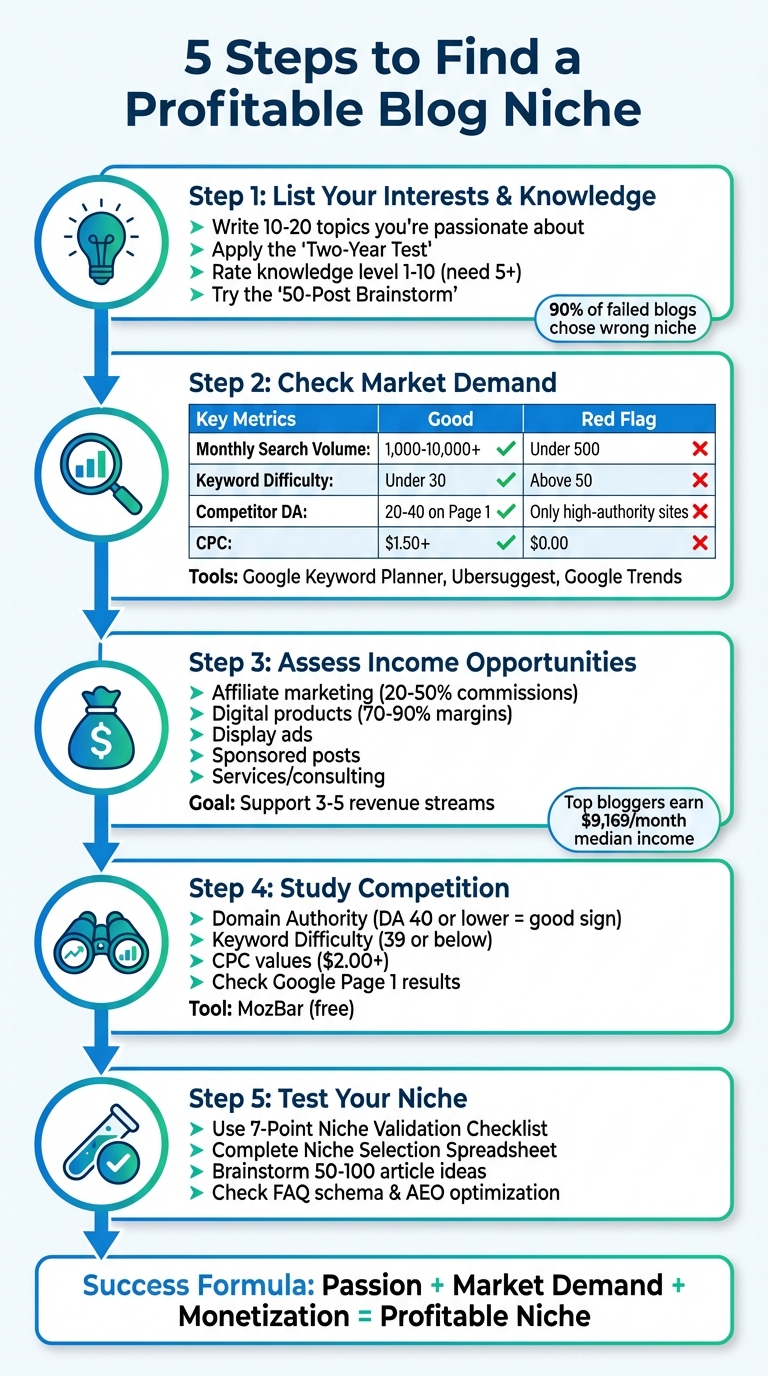
5-Step Process to Find a Profitable Blog Niche
How to Choose a Profitable Blog Niche as a Beginner (2026)
sbb-itb-112c64b
Step 1: List Your Interests and Knowledge Areas
Start by jotting down two lists: one for topics that excite you and another for areas where you have expertise. Aim for 10–20 topics in each list. The goal is to find where your passions and skills overlap – this combination is key to picking a niche that you can stick with.
Write Down Your Interests
Try using the Three-Column Method to organize your thoughts:
- Topics you could talk about endlessly.
- Areas where people often ask for your help or compliment your abilities.
- Problems you’ve solved or subjects you’ve studied.
Need inspiration? Check your bookmarks or social media activity. Sometimes your interests are hiding in plain sight.
Also, apply the "Two-Year Test": Can you see yourself creating content on this topic for two years straight? If the answer is no, cross it off the list. If you can’t imagine blogging about it long-term, it’s better to move on.
Evaluate Your Knowledge Level
You don’t need to be a world-class expert – just knowledgeable enough to guide beginners. Rate your comfort level with each topic on a scale of 1 to 10. A score of 5 or higher is a good starting point. Anything below that might require extra research before diving in.
The "Friends and Family" Test can also be helpful. Think about the topics where people naturally turn to you for advice. Sometimes, what feels easy or obvious to you is exactly where your expertise lies.
Before you commit to a niche, try the 50-Post Brainstorm. Write down 50–100 potential article ideas for each topic. If you struggle to come up with 30, the niche might be too narrow. This exercise not only helps you gauge your knowledge depth but also shows whether the topic has enough content potential to sustain a blog.
Once you’ve refined your list of interests and expertise, you’ll be ready to explore market demand in Step 2.
Step 2: Check Market Demand and Audience Size
Once you’ve pinpointed your interests, the next step is to make sure there’s an audience actively searching for content in your chosen niche. Even if a topic excites you, it won’t help your blog grow if no one else is looking for it. The key is finding a niche with enough demand to attract traffic, but not so competitive that you’ll struggle to stand out. Here’s how to assess the demand.
Use Keyword Research Tools
Begin by plugging your niche ideas into keyword research tools to gauge how many people are searching for related topics each month. Tools like Google Keyword Planner and Ubersuggest can give you the Monthly Search Volume (MSV) for your keywords. For new bloggers, focusing on keywords in the "Goldilocks zone" of 1,000–10,000 monthly searches is often a good starting point.
Another crucial metric to check is Keyword Difficulty (KD), which measures how hard it is to rank for a keyword. As a beginner, aim for keywords with a KD score below 30. Also, take a look at the Domain Authority (DA) of your competition. If websites with DAs of 40 or lower are ranking on the first page, it’s a signal that the niche might be more accessible. Don’t forget to check the Cost Per Click (CPC) – a CPC above $1.50 suggests strong buyer intent, which is a promising sign for monetization.
Here’s a quick cheat sheet to help you evaluate your findings:
| Metric | Good Sign | Red Flag |
|---|---|---|
| Monthly Search Volume | 1,000–10,000+ | Under 500 |
| Keyword Difficulty (KD) | Under 30 | Above 50 |
| Competitor DA | DA 20–40 on Page 1 | Only high-authority sites |
| CPC | $1.50+ | $0.00 |
You can also use free tools like Google’s autocomplete feature or the "People Also Ask" section to uncover long-tail keywords and popular questions. For a more detailed analysis, consider premium tools like Semrush or Ahrefs, which offer extensive keyword data. These tools cost $129–$139.95/month, but free options are often sufficient when starting out.
Review Trends and Search Data
Once you’ve confirmed that your niche has enough search volume, check Google Trends to see whether interest in your topic is stable, growing, or fading. Set the timeframe to five years to get a clear picture of long-term trends. A steady or upward trend is encouraging, while a sharp decline might indicate a dying niche.
Google Trends assigns a score from 0 to 100, with 100 representing peak popularity. Pay attention to terms marked as "Breakout" – these indicate a surge in interest of over 5,000%. Catching these early can help you tap into emerging opportunities before they become oversaturated. If you’re planning to create video content, switch the platform filter to "YouTube Search" and explore the "Related Queries" section set to "Rising" for ideas on trending sub-niches.
Beyond search data, explore platforms like Reddit and Quora to gauge community engagement. Active discussions and recurring questions often signal a passionate audience. Additionally, check Amazon for related products. If items in your niche have 100+ reviews, it’s a good indicator of a buying audience rather than just casual interest.
"The days of being able to succeed with a blog that covers everything and anything are long gone! … If you want to succeed at blogging in 2026, you need to niche right down".
Step 3: Assess Income Opportunities
Once you’ve confirmed demand for your niche, the next step is to determine if it offers reliable ways to generate income. A successful blog needs clear and varied revenue streams to thrive. Let’s dive into the different ways you can assess a niche’s profitability.
Identify Revenue Streams
Each niche comes with its own set of income opportunities. For example:
- Affiliate marketing: This is a go-to strategy for many bloggers. In niches like AI and SaaS, affiliate programs often offer recurring monthly commissions ranging from 20–50%. On the other hand, programs like Amazon Associates provide commissions of 4–15% on physical product sales.
- Digital products and courses: Selling items like e-books, templates, or online courses can yield profit margins of 70–90%, especially in areas like digital education and creator-focused businesses.
- Membership sites: Offering exclusive content through memberships can create a steady stream of recurring revenue.
- Services and consulting: Niches like business and finance lend themselves well to monetizing through coaching or done-for-you services, which can often generate income quickly.
- Display advertising: Networks like Google AdSense pay based on traffic volume. The industry average CPM is about $2.80, with publishers typically earning around $2.00 per 1,000 views.
- Sponsored posts and brand partnerships: These are particularly effective in niches like travel, food, and lifestyle where influencer marketing thrives.
"A blog is not a business. It is merely a promotional mechanism." – Blog Marketing Academy
For a niche to be truly sustainable, it’s wise to ensure it supports at least 3–5 revenue streams. This diversity helps safeguard against underperforming methods.
Target Niches with Strong Buyer Intent
In addition to having multiple monetization options, the best niches are those where buyers are highly motivated. Profitable niches often address pressing, costly problems that lead to quick purchasing decisions.
- Personal finance: This niche is a consistent top performer. Lead generation programs can pay $50–$200 per credit card or investment account signup. However, success here often requires authoritative, expert-driven content.
- AI and automation: This niche is booming, with global AI spending projected to hit $2.52 trillion by 2026, reflecting a 44% year-over-year growth rate.
- Health and wellness: Targeted areas like longevity and biohacking are gaining traction, with high-ticket items like smart rings and home saunas offering commissions of 8–20%.
- Pet industry: The U.S. pet market reached $152 billion in sales, with pet insurance leads alone paying $50–$100 each.
Bloggers in high-demand niches tend to earn significantly more, averaging $9,169 per month – 3.7 times the median income of most creators. However, it’s worth noting that 73% of creators still earn under $30,000 annually. To position yourself for success, focus on keywords that indicate buyer intent, such as "best", "review", "alternative", or "vs".
"Picking the wrong niche – one that is too broad, too competitive, or has no real buyer intent – is the number one reason new affiliate marketers fail." – Itamar Haim
Step 4: Study Competition and Profit Margins
Once you’ve confirmed niche demand and monetization potential, it’s time to dig into the competition and profit margins. This step helps refine your niche selection and ensures you’re making a smart choice.
Review Competitor Blogs
Checking out competitors is a great way to confirm that there’s real market demand. If there’s no competition at all, it might indicate a lack of interest or spending in that space. On the other hand, the presence of competitors suggests that people are willing to spend money in that niche.
Start by searching your target keywords on Google’s first page. If the results are dominated by big players like Forbes or Healthline, you’re likely up against tough competition. But if smaller blogs or solo creators show up, that’s a good sign. Use tools like MozBar (a free Chrome extension) to check the Domain Authority (DA) of these sites. Ideally, aim for niches where competing sites have a DA of 40 or lower.
Next, assess Keyword Difficulty (KD) scores and Cost-Per-Click (CPC) values. A KD score of 39 or below and a CPC above $2.00 are indicators of solid ranking and revenue potential.
To deepen your research, explore customer reviews of competitor products and join community discussions to understand audience needs and preferences. Additionally, check Amazon Bestseller rankings to confirm active consumer spending in your chosen niche.
Case studies show that carefully selecting a niche and consistently publishing content can lead to significant audience growth and revenue.
Once you’ve reviewed competitor metrics, it’s time to analyze profit indicators.
Compare Profit Metrics
After studying competitors, compare profit metrics to determine which niches offer the best revenue potential. Here’s a breakdown of key financial metrics across various niches:
| Niche Category | Average Commission Rate | Average Earnings Potential | Average CPC (High-Value) |
|---|---|---|---|
| Finance | 5% – 10% | $50 – $300 per sale | $15.50+ (Debt Management) |
| Real Estate | 5% – 25% | $100 – $1,000+ per lead | N/A |
| Make Money Online | 5% – 30% | $20 – $200+ per sale | N/A |
| Cybersecurity | N/A | High (VPN/Software) | $11.51+ |
| Productivity | 5% – 20% | $10 – $50 per sale | $9.80+ |
| Travel | 3% – 15% | $25 – $50 per booking | N/A |
| Pets | 5% – 8% | $15 – $75 per sale | $5.00 – $7.20 |
When evaluating niches, focus on Revenue per Visitor (RPV) rather than just traffic numbers. For example, niches like finance or B2B often generate higher RPV. Another crucial factor is cookie duration in affiliate programs. For instance, Semrush offers a 120-day cookie window, while Amazon’s is limited to just 24 hours – a major difference in your potential commissions.
Look for gaps in competitors’ revenue strategies. Are they missing opportunities like digital products, affiliate links, or consulting services? Businesses that follow structured market validation processes can achieve a 34% faster time-to-market. Additionally, narrowing a broad niche into a focused sub-niche can boost conversion rates by 23% to 47%.
"Successful bloggers generate 67% more leads when they write about topics that genuinely excite them, according to HubSpot’s latest content marketing research." – Ted Sawyer
Niches with trial conversion rates of 40% or higher are 73% more likely to succeed. Use this data to weigh the competition and profit potential, helping you zero in on the niche that’s right for you.
Step 5: Test Your Niche Using Blogger Outline Resources

Once you’ve assessed the competition and potential profitability, it’s time to confirm your niche choice with the help of tools and insights. Blogger Outline provides a range of resources to help you figure out if your niche has real income potential.
Access Blogger Outline’s Free Resources
Blogger Outline offers strategies tailored for SEO, specifically focusing on Answer Engine Optimization (AEO). This approach helps capture traffic from AI-driven search agents by incorporating FAQ schema markup and "Summary for AI" paragraphs. Considering that global AI spending is expected to hit $2.52 trillion by 2026, growing at 44% annually, aligning with these trends can be a game-changer.
The platform also emphasizes affiliate marketing opportunities, highlighting high-ticket programs and SaaS products with recurring commissions of 20–30%. This is particularly relevant when you consider that bloggers in top-earning niches report a median monthly income of $9,169 – 3.7 times the median income of general creators. Meanwhile, 73% of creators earn less than $30,000 annually.
In addition to affiliate insights, Blogger Outline provides WordPress tips to boost your site’s performance. For example, using lightweight themes and premium hosting can significantly improve page speed, which is crucial for maintaining strong search rankings. Another resource, The 100-Post Test, encourages you to brainstorm 50–100 article topics. If you struggle to come up with at least 20 viable ideas, it might indicate your niche is too narrow – a common issue for 90% of failed blogs.
Explore Blogger Outline’s Tool Recommendations
Beyond its free resources, Blogger Outline offers specialized tools to refine your niche strategy. One key recommendation is to target keywords with difficulty scores below 40, which can help your site rank faster. The platform also provides a 7-Point Niche Validation Checklist and a 3-Factor Validation Formula. These tools assess your niche based on factors like passion, demand (minimum 1,000 monthly searches), competition (keyword difficulty below 30), profitability, trends, expertise, and content depth.
Another valuable resource is the Niche Selection Spreadsheet, a downloadable tool that calculates a profitability score for your niche ideas. It evaluates eight elements, including market size, ad revenue potential, and affiliate opportunities.
With 45% of Americans currently engaged in side hustles, testing your niche thoroughly before launching your blog can give you a competitive advantage. These resources ensure your niche aligns with actual market demand, setting you up for success before you hit "publish" on your first post.
Conclusion
Choosing a profitable blog niche boils down to balancing your passion, market demand, and monetization opportunities. This combination is what sets thriving blogs apart from the majority that fail due to poor niche selection from the outset.
To simplify the process, follow these five steps: identify your interests and skills, use keyword research to confirm demand, explore potential income streams, evaluate competition, and test your niche with reliable tools. This method provides a clear roadmap, as highlighted by experienced bloggers and industry experts.
"If you choose a profitable blogging niche, but you are not interested in the topics of the niche, you will be burned out quickly. But, if you choose a niche that you are passionate about, yet there is little to no income potential, then why do you even start a blog?" – Jack Cao, WordPress and Online Business Expert
In 2026, niching down is more critical than ever. Broad categories like "health" or "travel" are dominated by established authority sites, leaving little room for new bloggers to compete. Instead, focus on a specific sub-niche to position yourself as an authority faster. By sticking to this five-step approach, you’ll ensure your niche is backed by data and has long-term potential. Before fully committing, confirm that your niche offers enough content opportunities. Leverage free tools and resources, such as those from Blogger Outline, to validate your choice and avoid relying solely on intuition. With the right niche, you’ll build a solid foundation for sustainable success.
FAQs
How do I pick a niche if I have too many interests?
If you’re having trouble deciding on a niche, start by jotting down your personal interests and passions. Then, dig into their potential profitability and how much demand exists for them. Look for niches that have a well-defined target audience, minimal competition, and solid opportunities to generate income. Using tools to analyze search trends and market feasibility can make this process easier. This way, you can choose a niche that’s not only interesting to you but also has the potential to be financially worthwhile.
How long should I validate a niche before launching my blog?
Experts suggest spending 3 to 6 months validating a niche before launching your blog. This period gives you the chance to assess key factors like demand, competition, and the potential for monetization. By dedicating time to this process, you can collect valuable data, make smarter decisions, and avoid diving into a niche that might not hold up over time.
What’s the fastest way to tell if a niche will make money?
To figure out if a niche can make money, start by looking at demand and competition. Check out audience interest, search trends, and how competitive the keywords are. You’re looking for steady interest and ways to make money, like affiliate programs or selling digital products. If there’s good demand but not too much competition, that’s a strong sign the niche could be profitable.