
Blog identity is what makes your blog stand out. It’s not just about a logo or tagline – it’s the voice, style, and personality that define how readers connect with your content. Here’s what you need to know:
- Key Elements: Blog identity is built on your niche (what you focus on), branding (visual and emotional aspects), and voice (your tone and style).
- Why It Matters: A clear identity builds trust, attracts loyal readers, and makes content creation easier.
- How to Create It: Define your niche, understand your audience, and create a consistent brand across platforms.
- Maintaining It: Regularly review your brand, stay aligned with audience needs, and adjust as trends evolve.
This guide will help you shape a strong blog identity that connects with readers and stands out in a crowded online space.
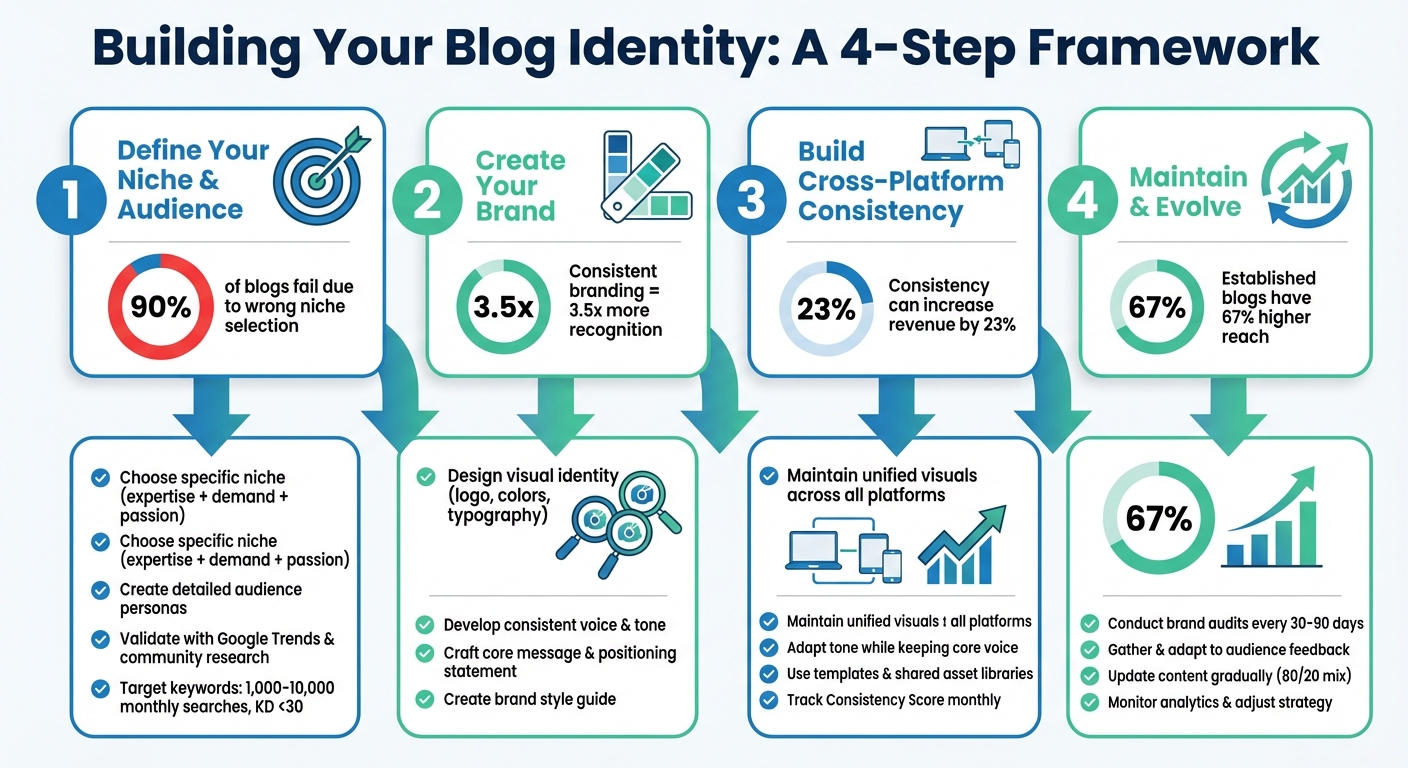
4-Step Process to Build a Strong Blog Identity
Defining Your Blog’s Niche and Audience
Choosing the Right Niche
Your niche is the backbone of your blog’s success. A staggering 90% of blogs fail because they pick the wrong niche from the start. This decision is one of the most critical you’ll make.
The sweet spot for your niche lies where your expertise, audience demand, and long-term passion intersect. If you miss any of these elements, you risk burning out, struggling to attract readers, or failing to monetize effectively.
Start by narrowing your focus. Instead of choosing a broad category like "fitness", hone in on something specific, such as "bodyweight workouts for office workers with lower back pain." Similarly, rather than a generic "food blog", consider something like "30-minute weeknight dinners for picky eaters." As Chris Geldof aptly puts it:
"Specificity is the cheat code. ‘Food blog’ is a category, not a niche. ’30-minute weeknight dinners for picky eaters’ is a niche".
To test your niche, try these methods:
- The Two-Year Test: Can you produce content on this topic for at least two years without running out of ideas or losing interest?
- The 50-Post Brainstorm: List 50 unique article ideas. If you can’t reach 30, your niche might be too narrow.
Validate your niche using Google Trends. Look at a five-year view to see if interest is stable or growing. Dive into communities like Reddit or Quora to uncover recurring questions or pain points from real users.
When targeting keywords, focus on those with a monthly search volume between 1,000 and 10,000 and a Keyword Difficulty (KD) score under 30. This gives you a realistic shot at ranking within 6–12 months.
Once your niche is locked in, the next step is understanding who you’re writing for.
Understanding Your Target Audience
Knowing your audience is the key to creating content that resonates. Demographics give you the basics – age, location, income, education. Psychographics dig deeper, revealing their values, fears, aspirations, and daily frustrations. You need both to paint a full picture.
Build a detailed audience persona – a profile of your ideal reader. Include their daily habits, motivations, challenges, and pain points. Having this persona documented helps keep your content focused and relevant.
Spend time in the online spaces where your audience gathers. Reddit, Quora, Facebook groups, and niche-specific forums are goldmines for understanding their struggles and unanswered questions. These gaps are your content opportunities.
Think about the customer journey. Are your readers just becoming aware of a problem? Are they researching solutions? Or are they ready to make a purchase? Tailor your content to meet them at each stage – whether it’s educational posts, comparison guides, or product reviews.
Aligning Niche and Content Strategy
Once you’ve defined your niche and audience, your content strategy should reflect this focus. Without a clear strategy, even the best niche can flounder. Blogs that try to cover too many broad topics – like productivity, recipes, and book reviews – often fail because they confuse both readers and search engines.
Stick to 3–5 core subtopics that support your niche. For instance, a blog about "seasonal baking for home cooks" could focus on ingredient sourcing, technique tutorials, recipe development, and kitchen equipment reviews. This structure keeps your blog organized and helps search engines recognize your authority.
Consider using the Core + Satellites model. Start by building deep expertise in one main area (your core). Once established, expand into related satellite topics that address adjacent audience needs. This approach keeps your content focused while allowing room for growth.
Before you launch, create a 12-month content calendar. Identify 100+ keywords along with their search volume and competition. This planning not only sets you up for long-term success but also reveals whether your niche has enough depth to sustain your blog over time.
sbb-itb-112c64b
Creating Your Blog Brand
Your blog’s brand is the personality that readers recognize and connect with. It’s what separates a casual hobby site from a professional platform that stands out. In fact, brands that maintain consistent messaging are 3.5 times more likely to be recognized in the market, and consistency across channels can increase revenue by 23%.
Establishing Your Blog’s Visual Identity
Your visual identity is the first thing readers notice, even before they engage with your content. It includes your logo, color scheme, typography, imagery, and layout – all working together to reflect your blog’s personality.
Start with your logo, which acts as the face of your brand. Keep it simple and adaptable. Decide whether a text-based wordmark, an icon, or a combination of both best fits your style. Make sure it looks great whether it’s displayed on a large banner or a tiny social media profile picture.
Next, focus on your color palette. Colors evoke emotions – blue suggests trust, red conveys energy, green symbolizes growth, and yellow brings optimism. Choose 1–2 primary colors, 2–3 secondary colors, and neutral tones like black, white, or gray. Save your hex codes to ensure consistency across all platforms.
Typography is like your brand’s voice in visual form. Pair a standout font for headings with a clean, easy-to-read font for body text. Serif fonts (like Times New Roman) often feel traditional, while sans-serif options (like Arial or Helvetica) give a modern vibe. Stick to two font families to keep things cohesive.
Imagery also plays a huge role. Whether you use photos, illustrations, or icons, maintain a consistent style – think filters, lighting, and composition. A style guide can tie all these elements together, outlining everything from hex codes and font sizes to logo placement and image usage. Tools like the WebAIM Contrast Checker can ensure your visuals are accessible to everyone.
Hiring a professional to design your brand identity can range from a few hundred dollars for freelancers to tens of thousands for agency work. Alternatively, AI branding tools now offer complete packages – including logos, color palettes, and typography – for as little as $29–$99, making it easier for bloggers to achieve a polished look.
While visuals grab attention, your blog’s voice keeps readers coming back.
Developing a Consistent Voice and Tone
Your brand voice is the personality that shines through in your writing, while your tone adjusts depending on the situation. For example, an investigative post might call for a formal tone, while a personal story could benefit from a conversational, warm approach.
To define your voice, pick three adjectives that describe it. For instance, you might aim for a tone that’s "friendly, informative, and approachable", or "bold, witty, and straightforward." Create a simple do/don’t list for each adjective to guide your writing style. A strong voice isn’t just about who your audience is – it connects with their deeper values, interests, and goals.
Keep your writing approachable by using short paragraphs (3–5 lines) and limiting punctuation to 1–3 marks per sentence. These small habits make your content easier to read and more engaging.
You can also develop a glossary of terms, product names, or unique phrases that reflect your blog’s identity. Documenting everything in a style guide – your "Sacred Cookbook" – ensures consistency as your team grows or guest contributors join your blog.
This voice becomes the foundation for a core message that ties your brand together.
Crafting Your Blog’s Core Message
Your core message is the heart of your blog. It defines what you offer and why it matters, shaping every piece of content you create.
Start by clarifying your blog’s purpose (why you exist), vision (the future you want to create), and mission (how you’ll get there). For example, if your purpose is helping busy parents simplify dinner, your vision might be a world where families don’t rely on takeout, and your mission could focus on sharing 30-minute recipes with seven ingredients or less.
Identify 3–5 core values – such as transparency, creativity, or reliability – that guide your work and resonate with readers. Then, craft a positioning statement like: "I help [audience] who [problem] so they can [benefit]". This statement keeps your messaging clear and focused.
Distill your brand into a memorable tagline – a short, catchy phrase of 3–7 words that sums up your promise. Use your About page to reinforce this message through storytelling. Share your journey, challenges, and what drives your passion. As Margaret Bourne explains:
"Branding includes your mission and values as a business and is conveyed through the way your brand looks visually as well as the tone you take on when speaking to your audience".
This personal touch makes your brand relatable and authentic.
Finally, check your social media bios, email signatures, and landing pages regularly to ensure they align with your core message. With over 600 million blogs out there, having a clear and consistent brand identity is what sets yours apart.
Building Brand Consistency Across Platforms
Your brand’s look and voice should feel the same no matter where someone finds you. Whether it’s Instagram, email, or LinkedIn, every interaction should scream, “This is us!” A mismatch in branding can confuse your audience and cost you trust, while a seamless presence has been shown to potentially boost revenue by up to 23%.
Think about it: the average person scrolls through over 300 pieces of content daily. If your Twitter feed feels disconnected from your website, people might not even realize it’s the same brand. The goal? Make every touchpoint instantly recognizable.
Social Media Branding
Every platform has its quirks, but your core branding – logo, colors, and fonts – should stay consistent. Start by creating a style guide that outlines key elements like:
- A primary logo and a simplified version for smaller spaces.
- A color palette of 2–3 main colors and 1–2 typefaces.
- Platform-specific templates that account for aspect ratios and safe text zones.
Tools like Canva Pro ($12.99/month) or Figma Professional ($12/editor/month) can help lock in your brand’s colors and fonts, ensuring no team member accidentally goes off-brand [30, 35]. Store these assets in a shared library, like Google Drive or Notion, so everyone always has access to the right files [30, 32].
Your branding should work at all sizes – tiny favicons, medium social posts, or large banners. For instance, make sure your logo stays legible at 40 pixels and that mobile text is at least 16 points. When exporting web assets, use an sRGB color profile to keep colors consistent across devices.
Your brand voice also needs to stay consistent, even as you adjust your tone to fit each platform’s vibe [36, 37]. LinkedIn might call for professional, thought-leadership content, while Instagram thrives on casual, visual storytelling. Twitter rewards short, punchy updates, and TikTok demands a more authentic, trend-savvy approach [37, 39]. Microbits sums it up perfectly:
"Your voice is your brand’s personality, the way it ‘talks’ no matter where it’s seen or heard… Your tone, though, is how that voice shows up in different places".
Create a "Voice Bible" to guide your messaging. Include approved vocabulary, emoji usage, and formatting tips. A "We Are/We Are Not" framework – like "We are expert but not condescending" – can help define your boundaries [37, 32]. To make life easier for your team, prepare canned responses for common comments and messages.
This consistency should extend to every partnership you take on.
Collaborations and Guest Blogging
When working with others, make sure your brand shines through. Before agreeing to a collaboration, check that the partner’s tone and audience align with your values. If you’re writing a guest post, adapt to their style without losing your core voice.
Be consistent with your author bio – use the same headshot, tagline, and blog link across all guest appearances. This repetition helps readers connect your name to your brand. For social media partnerships, like Instagram takeovers or webinars, share your logo files, color codes, and templates to ensure your brand is represented correctly. Always establish an approval process for any collaborative content [32, 34].
Once your partnerships are aligned, analytics can help you refine your approach.
Using Analytics to Refine Consistency
You can’t fix what you don’t measure. Analytics turn guesswork into actionable insights, ensuring your visuals and messaging hit the mark.
Start with monthly audits. Every 30 days, review your profile images, headers, and recent posts across platforms. Compare them to your style guide and look for issues like color inconsistencies, font substitutions, or logo misuse [30, 35]. Use a spreadsheet to track these details (e.g., platform, asset type, color hex, font).
Calculate a Consistency Score: (Visual Match % + Tone Match % + Asset Reuse %) / 3. This score, ranging from 0 to 100, helps you identify problems and trends early.
Track key performance indicators (KPIs) to validate your efforts. For example, aim for social media engagement rates above 2.5%, follower growth of 1%–3% per month, and click-through rates (CTR) of 3%–8% on your primary calls-to-action. Use tools like Buffer (starting at $6/month) or Later ($12.50/month) for multi-channel scheduling and basic analytics.
A/B testing can also refine your strategy. Try experimenting with two different visual styles or caption approaches over a few weeks, then compare the results in terms of engagement and Consistency Scores [30, 34].
As Forbes puts it:
"Consistency is key to building a strong brand. It’s not just about having a recognizable logo or color scheme; it’s about creating a cohesive brand experience that resonates with your audience".
Maintaining and Evolving Your Blog Identity
Your blog identity isn’t set in stone – it grows and shifts over time. As your interests evolve, your audience matures, and industry trends emerge, the challenge is to adapt without losing the trust you’ve built. Justin Brown, an entrepreneur and thought leader, sums it up perfectly:
"Your blog is infrastructure, not identity".
Your domain name, SEO value, and loyal readers are assets that can support a smooth evolution of your content.
In a crowded market, standing out means evolving in a way that feels natural and authentic. Take family vlogger Grant Khanbalinov as a cautionary tale – he lost 400,000 followers and saw a 99% drop in engagement after suddenly removing his children from his content. His experience highlights the importance of a thoughtful, gradual approach to change.
Consistency also plays a big role in maintaining reach. Established blogs with a steady posting history enjoy a 67% higher reach rate compared to newer profiles. Evolution doesn’t mean you have to choose between staying stuck in the past and completely reinventing yourself. Instead, it’s about a steady process that respects your personal growth while meeting your audience’s expectations. A key part of this process? Actively incorporating reader feedback.
Adapting to Audience Feedback
Your readers are your best compass when navigating change. Use surveys, comment sections, and direct messages to gather their input. If you’re considering a shift in focus, poll your audience to gauge their interest in new topics.
Ease them into changes with bridge content. For example, if you’re a food blogger transitioning into sustainable living, start by writing posts about reducing food waste or finding local ingredients. Over time – say, six months – adjust your content mix. Begin with 80% familiar topics and 20% new ones, then gradually reverse that balance.
Transparency is key. A dedicated post explaining your changes and the reasons behind them can go a long way in maintaining trust. And instead of deleting old content, archive it – it can still boost SEO and showcase your expertise. Trust is the foundation of a successful blog, and keeping your audience in the loop strengthens that bond.
Staying Relevant in a Changing Landscape
The blogging world moves fast, and staying relevant means focusing on changes that matter to your audience. Set up Google Alerts for key topics, follow industry leaders, and participate in community discussions to stay informed. Even as your topics evolve, your core purpose should remain steady. As Justin Brown warns:
"The mistake would be treating your blog as a monument to your past self rather than a vehicle for your current thinking".
If you’re planning to retire old revenue streams, make sure you have new ones – like partnerships or sponsored content – ready to go. Keep your "About Me" page up to date so it reflects your current mission and audience focus.
These ongoing adjustments naturally lead to regular brand audits, which ensure your blog stays aligned with both market trends and your readers’ expectations.
Periodic Brand Audits
A yearly brand audit – or one conducted before major changes like a rebrand or niche shift – helps keep your blog’s identity on track. A thorough audit should cover three key areas:
- Internal Branding: Your mission and values.
- External Branding: Visual elements like your logo and messaging.
- Customer Experience: How readers interact with your content.
Ask yourself tough questions: Does your visual identity align with your current content? Is your tone consistent across platforms? Are your core values still guiding your decisions? Comparing where you are now with your original vision can reveal whether you’re evolving intentionally or drifting off course.
Consistency builds credibility, and a deliberate evolution fosters long-term engagement. Document changes to your color palette, fonts, or logo in a central location so everyone involved in content creation stays on the same page. Tools like Canva or Adobe can help you maintain a polished look as your brand evolves.
Finally, dig into your analytics during each audit. Identify which older posts still drive traffic and which new topics are resonating with readers. This data will show whether your audience is embracing the changes – or if you need to tweak your approach further.
Conclusion
Key Takeaways
Start by establishing a strong foundation for your brand: define your mission, values, and niche clearly. From there, create a visually unified system that reflects your identity. Consistency in your voice and tone across posts, updates, and newsletters is equally important.
Understanding your audience is key. Use detailed reader personas to craft content that directly addresses their needs and challenges. Once these elements are in place, ensure your branding stays consistent across all platforms to foster recognition and trust. As Gia Mayo, a Canva expert, explains:
"Branding includes your mission and values as a business and is conveyed through the way your brand looks visually as well as the tone you take on when speaking to your audience".
Remember, your blog’s identity is not set in stone. Conduct regular brand audits – every 30 to 90 days – to ensure your messaging aligns with your goals and continues to resonate with your audience. Keep an eye on analytics, interact with your community through comments and social media, and make adjustments as needed to stay relevant in a changing landscape. Building trust is essential, and a consistent yet adaptable brand is how you achieve it.
With these strategies in mind, you’re well-prepared to take your blog’s identity to the next level.
Next Steps for Bloggers
To move forward, try drafting a positioning statement using this simple formula: "I help [audience] who [problem] so they can [benefit]". Use this statement in your tagline, on your About page, and in pitches. Next, create a brand kit with tools like Canva to store your logos, HEX color codes, and font choices in one accessible place.
Plan your content using a calendar, working in three- to four-week cycles. Focus on three core topic areas that align with your audience’s needs. Review your existing content to ensure it reflects your brand identity. With consistent effort, you’ll likely see noticeable progress within six to 12 months. Stay dedicated, listen to feedback, and refine as you go. Your blog identity serves as the connection between you and your readers – build it thoughtfully and nurture it over time.
FAQs
How do I pick a niche that won’t burn me out?
To steer clear of burnout, it’s crucial to pick a niche that strikes the right balance between what you’re passionate about, what your audience wants, and what can work over the long haul. Choose topics you truly enjoy and feel confident creating content about regularly. Take the time to research what your audience is interested in and whether the niche offers opportunities for monetization – it’s important to ensure it’s practical as well as engaging. Also, be honest with yourself about your ability to handle the workload without losing steam. When your niche matches both your interests and realistic goals, it’s much easier to stay motivated and avoid feeling overwhelmed.
What should I include in a simple blog style guide?
A simple blog style guide helps keep your content consistent and professional. Here’s what it should include:
- Mission, Audience, and Topics: Define your blog’s purpose, target readers, and core topics to maintain focus and relevance.
- Tone, Voice, and Language: Set clear guidelines for how your blog should sound – whether casual, formal, or somewhere in between.
- Visual Standards: Outline preferences for colors, fonts, and image styles to ensure a cohesive look.
- Formatting Rules: Specify how to structure headings, paragraphs, and lists for readability and uniformity.
- SEO and Keywords: Provide instructions for optimizing content with keywords without compromising quality.
- Contributor Guidelines: Offer clear directions for guest writers to ensure their work aligns with your standards.
By following these guidelines, your blog will reflect a polished and unified brand identity.
How can I evolve my blog without losing readers?
To keep your blog growing while holding onto your readers, focus on maintaining a consistent brand identity as you make gradual updates. Start by auditing your content to see what connects best with your audience. Define a clear mission that reflects your goals and ensure your visuals and messaging are aligned with that mission. A detailed style guide can help keep everything consistent across the board.
When making changes, be upfront with your audience. Transparency builds trust and helps readers feel included in your journey. Striking the right balance between fresh ideas and familiar elements is key to evolving without pushing your audience away.